

A sewer line backup isone of those plumbing problems that can go from inconvenient to disastrous very quickly. When wastewater cannot move through the sewer line properly, it has to go somewhere, and that can mean a backed-up toilet, overflowing drain, or contaminated water inside your home.
We regularly help homeowners in Mesquite and throughout the DFW area figure out why their sewer lines are backing up. The underlying problem can be something relatively simple, such as a blockage, or something more serious, such as tree-root intrusion, a collapsed pipe, or damage to an aging sewer line.
Understanding the common sewer line backup causes can help you recognize trouble earlier and know when it is time to call a professional.
Common Causes of Sewer Line Backups
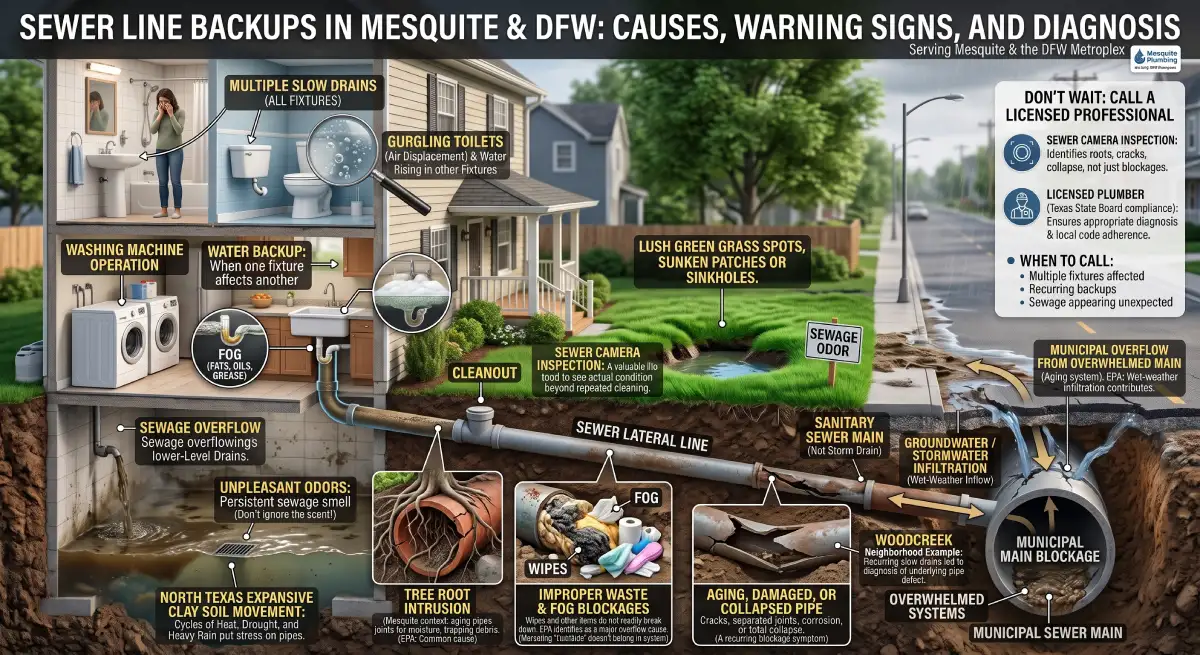
Grease, Waste, and Other Blockages
One of the most common causes is simply a blockage that prevents wastewater from flowing normally.
Grease and cooking oils cool and solidify inside the pipe, gradually narrowing the passage. Wipes, paper products, and hygiene products that don’t break down readily create similar problems. The EPA identifies such blockages as a major cause of sewer overflows. Something marketed as ‘flushable’ doesn’t necessarily belong in your sewer system.
Tree Root Intrusion
Tree roots are another major cause of sewer problems, particularly in established North Texas neighborhoods.
Roots do not usually break through an otherwise perfect modern sewer pipe simply by force. Instead, they take advantage of cracks, separated joints, or other weaknesses where moisture is available. Once inside, roots can grow and trap other debris, progressively restricting the line.
The EPA identifies tree roots entering through defects or openings as a recognized cause of sewer blockages. (epa.gov)
This can be particularly relevant around older DFW homes with aging cast-iron or clay sewer lines and mature landscaping. If a line has recurring blockages despite repeated cleaning, we start wondering whether the pipe itself has a structural problem.
Damaged, Collapsed, or Aging Sewer Lines
Sometimes the blockage is actually a symptom of a failing pipe.
Older sewer lines can develop cracks, separated joints, corrosion, root intrusion, or other structural defects. In more serious cases, part of the pipe can collapse, leaving wastewater with little or no path through the line.
North Texas soil movement can also put stress on buried infrastructure. Expansive clay soils respond to changes in moisture, and the region’s cycles of intense heat, drought, and heavy rainfall can create challenging conditions for underground plumbing.
A sewer camera inspection is particularly valuable when we suspect this type of problem because it allows us to see the actual condition of the pipe rather than repeatedly treating the blockage without addressing its cause.
Heavy Rain and Stormwater Infiltration
North Texas storms can contribute to sewer problems in another way.
Sanitary sewer systems are designed primarily for wastewater, not large volumes of stormwater. When aging or damaged sewer pipes allow groundwater or stormwater to infiltrate through cracks, defective joints, or improper connections, heavy rainfall can increase the volume moving through the system.
The EPA specifically identifies wet-weather infiltration and inflow as contributors to sewer overflows and operational problems. For homeowners, that can mean a sewer line that appears to work normally most of the time suddenly struggles during or after a major storm.
Early Warning Signs of a Sewer Backup
The worst time to discover a sewer problem is when wastewater is already coming across your bathroom floor. Fortunately, there are often warning signs beforehand.
Multiple Drains Start Moving Slowly
One slow drain does not necessarily mean a sewer line problem. A clog in a bathroom sink, shower, or kitchen drain is often localized.
When several drains throughout the house begin slowing down at the same time, however, we become much more suspicious of a problem farther downstream.
If the shower, toilet, bathtub, and sinks are all behaving differently than usual, the issue may be in the home’s main drain or sewer line rather than at any individual fixture.
Toilets Gurgle or Water Rises in Another Fixture
Gurgling toilets can be another early warning sign.
When wastewater encounters a restriction in the sewer line, air can become trapped or displaced, producing bubbling or gurgling sounds. You may also notice water rising in a shower or bathtub when a toilet is flushed or the washing machine drains.
We consider this particularly important because it tells us that wastewater is not moving through the system normally.
Sewer Odors
A persistent sewage smell inside or around your home should not be ignored.
A healthy drainage system should keep sewer gases contained within the plumbing system. If you suddenly notice strong sewage odors, particularly alongside slow drains or gurgling fixtures, we recommend having the system evaluated.
The problem could be a damaged drain, dried trap, venting issue, or sewer-line problem. Identifying the actual source matters because masking the smell does not address the underlying plumbing issue.
Recurring Backups
If you have already had the sewer line cleared once and the same problem keeps coming back, we recommend looking beyond the immediate blockage.
Repeated backups can indicate recurring root intrusion, grease accumulation, a damaged pipe, or another structural problem. Continually cleaning the line may provide temporary relief without solving the reason it keeps becoming blocked.
When Should You Call a Professional?
We recommend calling a licensed plumber when multiple fixtures are affected, backups are recurring, sewage is appearing where it should not, or you suspect the main sewer line is involved.
A professional evaluation is especially important when a drain cleaning only provides temporary relief. At that point, we want to determine whether there is a deeper problem rather than simply clearing the same obstruction again.
We may use a sewer camera to inspect the line and identify roots, cracks, collapsed sections, heavy buildup, or other defects. That information helps determine whether the appropriate solution is cleaning, repair, lining, or full replacement.
There is also a Texas-specific reason to use a properly licensed professional. The Texas State Board of Plumbing Examiners notes requires plumbing work to comply with all applicable state and locally adopted plumbing codes. That means the right repair isn’t just the one that gets wastewater moving – it needs to be appropriate for your property and local requirements.
A Small Backup Can Point to a Bigger Problem
We recently dealt with the kind of situation that illustrates why we encourage homeowners to pay attention to recurring symptoms.
A homeowner in the Mesquite’s Woodcreek neighborhood had experienced several slow drains and an occasional toilet backup. Each time, the immediate problem seemed to clear up, so there was little reason to think beyond the blockage.
When the symptoms returned, however, the sewer line was inspected rather than simply cleared again. The underlying problem turned out to be further down the line, where an older section had developed a defect that was allowing debris and roots to interfere with normal flow.
The important lesson was not that every backup requires sewer replacement. It was that recurring sewer line backups deserve a diagnosis. Clearing the symptom without finding the cause can leave homeowners dealing with the same emergency repeatedly.
Don’t Wait for a Full Sewer Backup
If you’re experiencing slow drains, gurgling toilets, or recurring backups in Mesquite or anywhere in DFW, we’re ready to help. We’ll diagnose the problem, explain your options, and give you a straight answer about what your sewer line actually needs.
The earlier we identify the issue, the more options we’ll have for dealing with it before wastewater causes extensive damage inside the home. Contact Mesquite Plumbing today to schedule an evaluation.