

After the spring 2024 storms dumped 6+ inches of rain across Mesquite in a single week, our phones rang off the hook. Homeowners who’d never thought about drainage before were suddenly looking at standing water in their yards and asking: “Do I need a sump pump?” The answer wasn’t always yes – and that surprised a lot of them.
North Texas homes face a unique combination of heavy rain events, expansive clay soils, changing moisture levels, and generally flat terrain. At the same time, many DFW homes are built on concrete slabs rather than full basements, which means the drainage solutions that make sense in other parts of the country may not always apply here.
We believe the best way to answer the question is to start with the drainage conditions around the home. If water is consistently collecting near your foundation, a sump pump may be part of the solution, but it may not be the first or only step we recommend.
Here is what we look for when evaluating drainage problems and deciding whether a North Texas home would benefit from a sump pump.
Signs of Poor Drainage Around Your Foundation
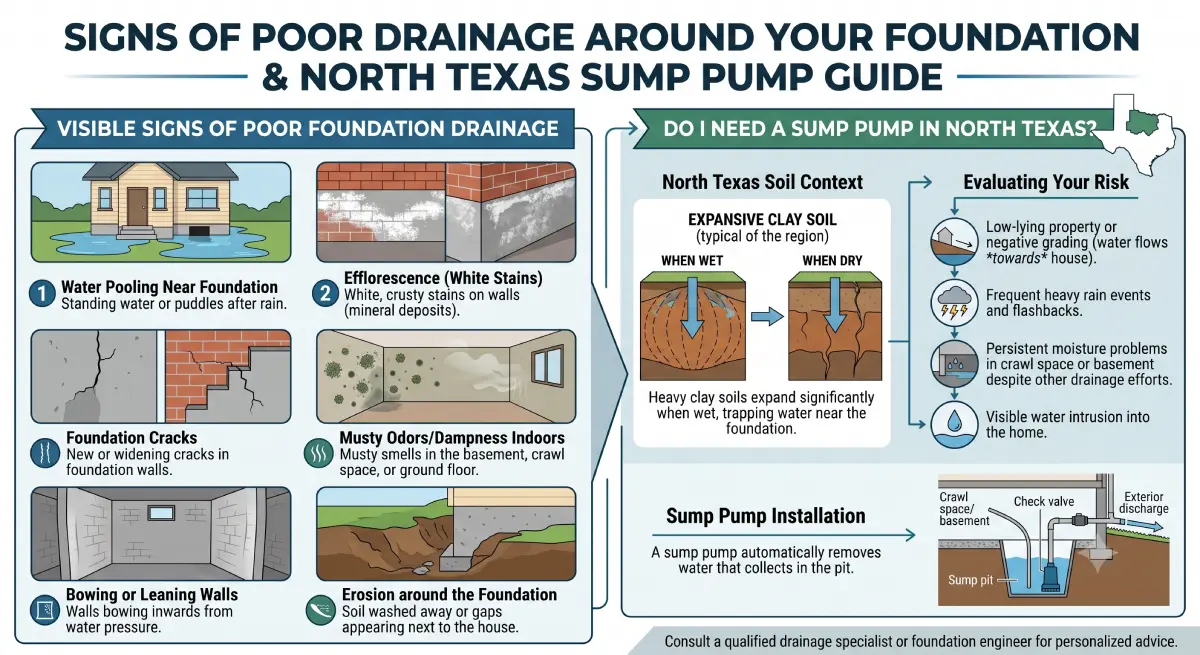
1. Water Pools Near the Foundation After Rain
One of the clearest warning signs is standing water that remains around your foundation after a storm.
A little temporary puddling is not necessarily an emergency, particularly after one of the intense thunderstorms we can experience across the DFW area. However, if water repeatedly collects against the house or remains in the same location for hours or days, we recommend taking a closer look.
The ground immediately surrounding your home should generally direct rainwater away from the foundation rather than allowing it to accumulate beside it. When the soil stays saturated, water has more opportunity to work its way into cracks, joints, or other vulnerable areas.
In Mesquite and across North Texas, heavy rainfall can expose drainage problems that may not be obvious during dry weather. If you only notice the issue after a major storm, that does not necessarily mean the problem is insignificant. It may simply mean that your drainage system is being overwhelmed when the ground is already saturated.
2. Soil Is Washing Away or Eroding
Take a look at the soil around your home after a significant rainfall. Do you see channels carved into the ground? Are there areas where mulch or topsoil has washed away? Is water visibly flowing toward the foundation?
These can all indicate that rainwater is not being controlled effectively.
Erosion can be especially noticeable around downspouts. A concentrated stream of water discharged directly beside the house can wash away soil over time, potentially creating low spots where even more water collects.
We recommend checking these areas after heavy rain, when the path of water is easiest to see. A drainage problem that is difficult to identify on a sunny afternoon can become obvious within minutes of a North Texas thunderstorm.
3. Cracks or Other Signs of Foundation Movement Appear
Foundation movement is a complex subject, and we would never suggest that every crack in a home is caused by poor drainage. However, changes in the moisture conditions around a foundation can contribute to problems, particularly in areas with expansive clay soils.
Texas A&M AgriLife Extension notes that clay soils can hold significant amounts of water and have different drainage characteristics from sandy soils. North Texas homeowners also know that our weather can swing from extremely wet periods to extended dry spells. That combination makes consistent moisture management around the home particularly important.
We see this most often in Mesquite neighborhoods like Woodcreek and Pecan Creek, where the soil is particularly heavy and drainage can be challenging after prolonged rain. If you notice new or widening cracks, doors that suddenly stick, uneven floors, or other signs that concern you, we recommend having the issue evaluated by an appropriate foundation professional. At the same time, we can help identify whether plumbing leaks or drainage-related water issues could be contributing to the problem.
4. Downspouts Discharge Too Close to the House
Your gutters can collect enormous amounts of rainwater, but they only help protect your foundation if that water is discharged properly.
One of the most common drainage issues we see is a downspout that releases water directly at the foundation. Instead of carrying roof runoff away from the house, the system concentrates a large volume of water in one small area.
We recommend checking every downspout around your home and making sure the discharge point is not creating a recurring wet spot beside the foundation. Extensions, splash blocks, or other drainage improvements may be appropriate depending on the property.
The important point is that a sump pump should not be used to compensate for a simple downspout problem. If the water can be redirected away from the house through proper surface drainage, that is often a more direct solution.
What That Looks Like in a Real Mesquite Home
Last year, we got a call from a homeowner in Mesquite’s Woodcreek neighborhood. They’d noticed standing water in their crawl space after every storm – not enough to flood, but enough to keep the space constantly damp. A previous contractor had recommended a sump pump installation without even looking at the grading.
When we walked the property, we found the real problem: a downspout that was discharging directly against the foundation, and grading that sloped toward the house. The water had nowhere to go but under the home.
We redirected the downspout with an extension, regraded a small area, and installed a French drain to carry water away from the structure. The crawl space stayed dry through the rest of the rainy season – and they didn’t need a sump pump at all.
That homeowner now has our number saved in their phone – and a much better understanding of how drainage problems start.
Do I Need a Sump Pump in North Texas?
Slab Homes and Basements Have Different Needs
For many DFW homeowners, the answer to “Do I need a sump pump?” starts with the type of foundation your home has.
Most North Texas homes are built on concrete slabs rather than full below-grade basements. In a typical slab-on-grade home with good grading, functioning gutters, and no history of groundwater intrusion, a sump pump may not be necessary.
That does not mean slab homes are immune to water problems. Plumbing leaks, poor surface drainage, stormwater runoff, and foundation drainage issues can still create serious concerns. However, the solution is often different from what we would recommend for a home with a basement.
Basements and other below-grade spaces are naturally more vulnerable to groundwater and water intrusion. A sump system can collect water at a low point and pump it away before it floods the space.
Building-code requirements also depend on the home’s design and the applicable code adopted by the local jurisdiction. The International Residential Code, for example, includes provisions for drainage systems serving certain basement foundation conditions and allows drainage to be handled by gravity or mechanical means in specified circumstances. That is different from saying that every home in North Texas is required to have a sump pump.
For that reason, we recommend looking at your specific home rather than assuming that a sump pump is automatically required – or automatically unnecessary.
North Texas Clay Soil Can Complicate Drainage
Clay soil is another major part of the North Texas equation.
Texas A&M AgriLife Extension explains that clay soils tend to hold more water and have different drainage characteristics than sandy soils. In practice, that can make it harder for heavy rainfall to move through the ground quickly, particularly when soil is compacted or already saturated.
That matters around a foundation because water that cannot drain away efficiently may remain in the soil near the home.
At the same time, we do not recommend assuming that clay soil automatically means you need a sump pump. A pump can move water from a collection point, but it does not fix every underlying drainage problem. If the primary issue is poor grading, a misplaced downspout, or inadequate surface drainage, correcting that problem may be more effective.
We look at the whole drainage picture before recommending a solution.
How We Generally Think About Sump Pumps
Here’s a simple framework we use when evaluating whether a home needs a sump pump:
- Finished basement or below-grade living space → Sump pump is often recommended to protect finished areas from groundwater intrusion
- Slab-on-grade home with no history of water issues → Likely not needed, provided grading and gutters are functioning properly
- Crawl space that’s consistently wet or humid → Sump pump may be part of the solution, but grading and downspouts should be addressed first
- Standing water in the yard after every storm, regardless of foundation type → Start with grading, downspouts, and surface drainage improvements, then evaluate sump pump
The goal is to keep water away from your home, not just move it from one place to another.
Protect Your North Texas Home From Drainage Problems
Poor drainage can become more than an inconvenience when water repeatedly collects around your foundation. In North Texas, where heavy storms and challenging clay soils can put drainage systems to the test, it is worth paying attention to the warning signs.
If you’ve read this far, you know more about foundation drainage than most homeowners in North Texas. We’d genuinely rather you ask us about your grading, your downspouts, and your specific soil conditions than guess whether you need a sump pump.
We’ve been working in Mesquite and across DFW long enough to know that the answer isn’t always what you’d expect. Sometimes it’s a simple grading fix. Sometimes it’s a downspout extension. Sometimes it’s a French drain. And sometimes, yes, it’s a sump pump.
When you’re ready to talk to a team that understands North Texas drainage challenges, reach out to us. We’ll walk your property, check your grading and downspouts, and give you a straight answer about what your home actually needs.
Contact Mesquite Plumbing today to schedule an evaluation and get professional advice from a licensed plumber who understands North Texas homes.